According to Mehrdad and Ehsani, the main problem of gas-powered vehicles is that the engine fuel efficiency characteristics are mismatched with the real operation requirements, dissipation of vehicle kinetic energy during braking, especially while operating in urban areas and low efficiency of hydraulic transmission in current automobiles in stop-and-go driving patterns. Understanding these disadvantages, battery-powered electric cars can provide some advantages over conventional ICE vehicles, such as high energy efficiency and zero environmental pollution. However, the performance, especially the operation range per battery charge, is far less competitive than ICE vehicles, due to the lower energy content of the batteries vs. the energy content of gasoline. Hybrid electric vehicles (HEV) use two power sources, the internal combustion engine ICE and electric motor EM. This article proposes a brief review about the main types and features of hybrid electric vehicles HEV.
HEV definition
An HEV is defined as a vehicle that has two or more energy sources and energy converters is called a hybrid vehicle [Mehrdad and Ehsani].
Operation modes
The varied operation modes in a hybrid vehicle create more flexibility over a single power train vehicle. With proper configuration and control, applying the specific mode for each special operating condition can optimize overall performance, efficiency, and emissions.
Efficiency


Operating each power train in its optimal efficiency region is essential for the overall efficiency of the vehicle. An IC engine generally has the best efficiency operating region with a wide throttle opening. Operating away from this region will cause the efficiency to suffer a lot. On the other hand, efficiency suffering in an electric motor is not as detrimental when compared to an IC engine that operates away from its optimal region. The IC engine or the fuel cell can be much smaller than that in a single power train design because the dynamic power is taken by the dynamic power source, and can then operate steadily in its most efficient region.
HEV types
The HEV are, until now, classified into four kinds:
- series hybrid;
- parallel hybrid;
- series–parallel hybrid;
- complex hybrid.
Series hybrid
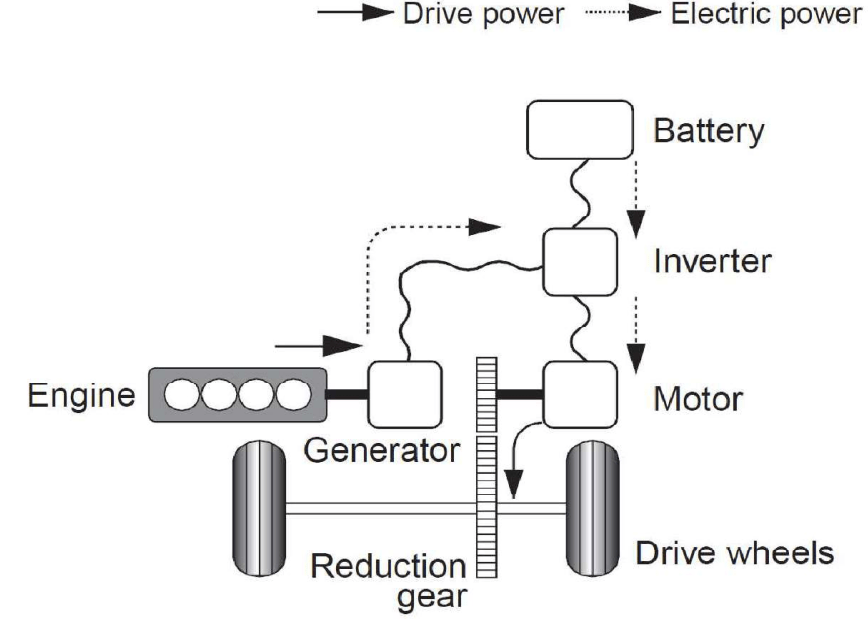
The engine is fully mechanical when decoupled from the driven wheels. Therefore, it can be operated at any point on its speed–torque characteristic map, and can potentially be operated solely within its maximum efficiency region as. Because electric motors have near-ideal torque–speed characteristics, they do not need multigear transmissions. Simple control strategies may be used as a result of the mechanical decoupling provided by the electrical transmission. However, The energy from the engine is converted twice (mechanical to electrical in the generator and electrical to mechanical in the traction motor). The inefficiencies of the generator and traction motor add up and the losses may be significant. The generator adds additional weight and cost. The traction motor must be sized to meet maximum requirements since it is the only powerplant propelling the vehicle.
Parallel hybrid system

In parallel hybrid system (PHS) the ICE and EM are capable to traction the vehicle. This is the main feature of this architecture since there is no connection between ICE and EM. The EM also operates as an electric generator to charge the battery during braking or downhill passing. To couple the ICE and the EM it is needed a transmission system that englobes not onlya coupling mechanism but also reduction gears.
Power split hybrid system

Also called series/parallel hybrid system, this architecture provides a connection between the ICE and the electric generator through a power split device. This configuration is similar to the parallel due to both the ICE and the EM can traction the wheels. The difference is that the ICE have your function expanded. It can be operated as an electric generator and/or traction motor together with the EM or alone. The power split configuration almost has the same features of the PHS. It is a complex electric and mechanical transmission system, but operates in wide range of performance that make the vehicle able to run even more efficiently if compared to the SHS and PHS.
References
- Ebrahimi, Kambiz M. Ehsani, Mehrdad_ Gao, Yimin_ Longo, Stefano. Modern electric, hybrid electric, and fuel cell vehicles. CRC Press, 2018.
 Automotive Papers