
When a vehicle travels it leaves a trace which represented by its wake. Although in most of conditions it is not possible to visualize a wake, it is possible to evaluate its effects in terms of energy. Wakes usually result in vortices produced at some distance from the vehicle tail, the amount energy contained on these depends of some parameters. Considering an elementary vortex:

The main characteristic of an elementary vortex is the curve obtained when plotted the graph of the circulation by its radius. However, to a blunt body applications (in which the automobiles are considered), the use of the Rankine Vortex model is usually suggested. This is given by the following set of equation and parameters:
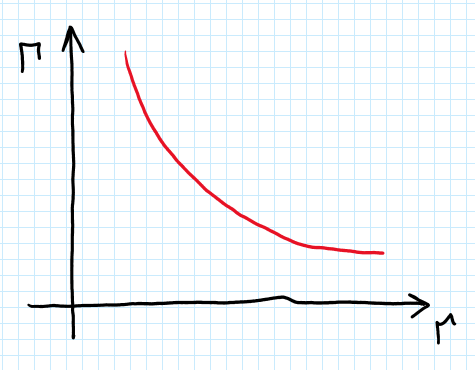

However, in Rankine Elementary Vortex model occurs in a different path (highlighted in green) compared to elementary vortex. In other words, the circulation for a same vortex with radius “a” has a different behavior. Hence, considering the parameters:
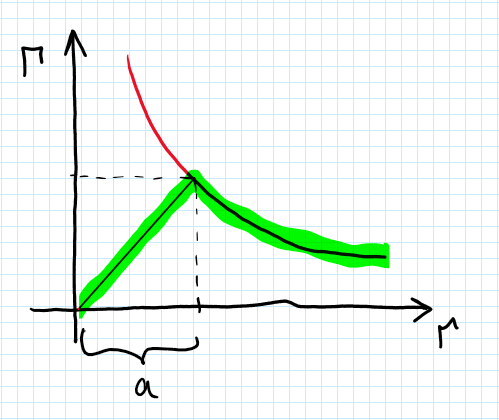
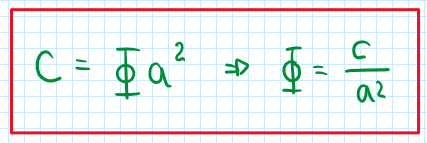
Thus, the equation for the rankine elementary vortex model are:
From this step it is possible to evaluate kinect energy of the wake and to check the four main characteristics of the rankine elementary vortex. The kinect energy on this model is proportional to the square value of the vorticity:
The main characteristics of the wake
The main parameters which describes the energy content in a wake are:
- Strenght;
- Size;
- Vortex Coherence;
- Distance between two rows.
Strength
To evaluate the strength, the parameter “a”, which is the vortex size, is hold constant as the strength changes. Understanding that the behavior of the rankine elementary vortex is the one give by the following curve (green path):
The following development can be written:

As can be seen on the calculation developed above, even though those vortices have the same same, the energy content can be different. In this example, the vortex 1 has a higher a kinect energy. This occurs due to different reason, which justify the verification of the vortex size.
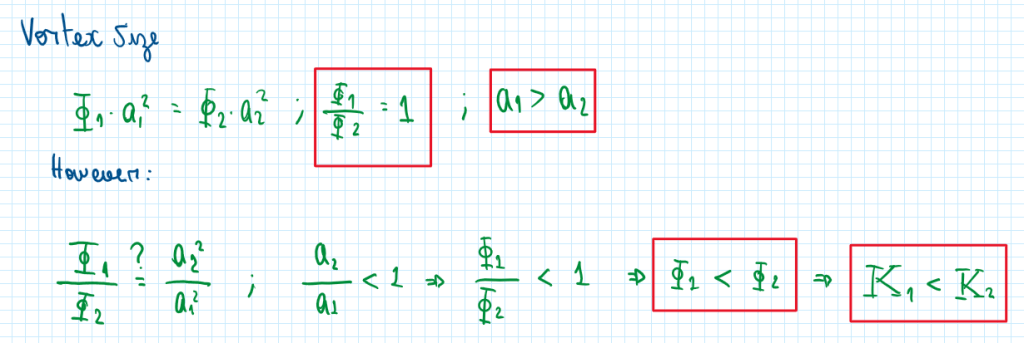
Vortex size
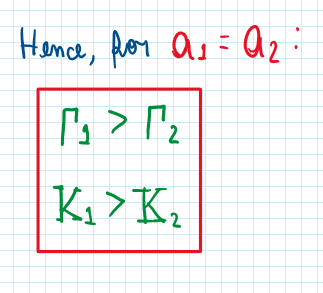
Using the same procedure as in the previou parameters, to analyze the vortex size (a) it is required to hold constant the strength. Hence, considering two vortices with the same strength, it can be written:
Vortex coherence
Coherence means how organized is the flow after the vehicle displacement. The wake left behind from a bluff body appears more coherent or organized when a high kinect energy was transfer to the flow.
Distance between the two rows
In general the tail of a vehicle left behind two vortices, one at each side of the car. This part of the flow usually came from lateral of the vehicle body and encounter the flow which cames from the roof. The vortices generated usually has a distance, which increases when this distance increases.
References
- Stalio, Enrico. Aerodynamics. October, 2021;
- http://www.aerodinamica.unimore.it
 Automotive Papers