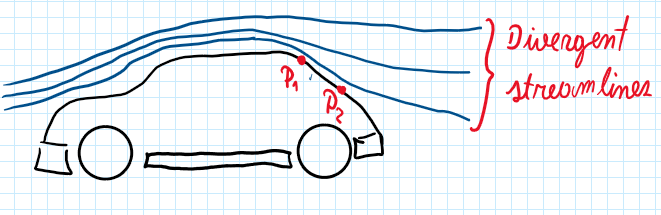
Considering that a flow over a car will diverge at certain points. In addition, assuming that the air mass flow rate and the density are constant, it is possible to consider that the velocity v times the streamtube surface area is constant also. Therefore, for a vehicle under these conditions the separation point which could provide a better performance is a slightly far the previous one. The reasons are:
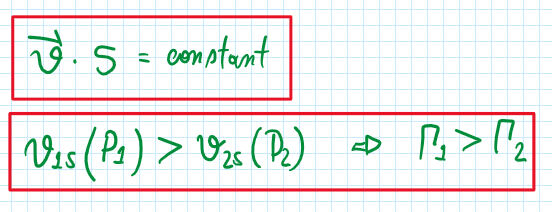
- The separation velocity at point 1 is higher than the one at point 2, which results in higher vortice strength;
- The divergence between the streamlines is smaller;
- The boundary layer thickness is lower at P1 than at P2;
- The coherence will be higher where there are more kinect energy.
These details suggests that if separation occurs at P1, the boundary layer thickness at this point is higher than at P2, thus a1 is also higher than a2 (“a” is the vortice size), because the vortice diameter are of the same order of magnitude than 2 times the boundary layer thickness at separation point. In addition this results in a flow with lower energy, K1 < K2. The coherence is also lower at K1 which agrees with the previous conclusions. Moreover a higher vortice strength is generated at P1 and the distance between the vortices when separating at this point is lower than at P2, thus lower kinect energy at the first point.
This suggests that a downstream divergence is better for drag. Actually, a turbulent boundary layer is beneficial for the drag (D) of a blunt body. The coherence between a turbulent flow and a laminar one is also different, the first case is benefical (aL < aT –> KT < KL) and also helps to reduce the kinect energy when the flow separates at P2.
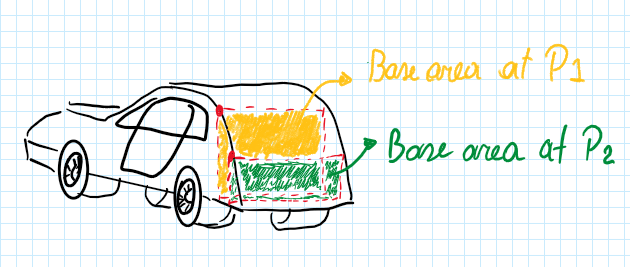
Therefore, the separation occuring at P2 provides a lower kinect at a zone of the rear of the car which has a lower base area, which is the main reason of the drag reduction. Assuming that the shape of the car is convenient to hold the streamline attached, the flow when separating at P2 exhibits a lower divergence and coherence.
References
- Stalio, Enrico. Aerodynamics. October, 2021;
- http://www.aerodinamica.unimore.it
 Automotive Papers