
The tire thread volume is a deposit of chemical energy, as the thread wears, the energy is being consumed. Actually, the thread of each tire is a fixed deposit of energy, but with a limited amount of it. A good analogy is that the thread is a kind of batery, as the thread is being worn, its thickness is reduced, thus less heat is generated by friction. The energy produced can be described by the following equation:
∫0EOL (F∙σ)dt = ∫0EOL(F∙V)∙(1/V)dt
Where F is the generalized force vector (Fx and Fy), σ is the generalized slip vector (vx and vy) and EOL refers to the end of lap or any other upper limit relative to the amount of laps. This equation helps to understand the tire durability, thus make predictions about how long a stint can be. However, the simple correlation is valid, as more power is requested, less laps the tire will last.
Tire wear
Since energy is a function of the thickness of the tire thread, its wear results is loss of performance. Although this is expected, there are some problems caused by wear that are not previewed. There are three types of tire degradation, the surface, thermal and chemical degradation. However, there is an important detail about wear on tires, this is a total non-uniform phenomena. Several reasons can explain this. Basically, tire are the primary source of energy, it is exposed to the driver inputs, load transfer, track layout, tire compound and the environmental conditions. Hence, understanding that degradation are never equal due to transients, it is possible to better compreheend the tire thread degradation.
Surface degradation
The thread is the main point here. Actually, the tire thread can indicate some informations as slip angles and car setup, because it wears according to these two factors. Hence, it is important to understand the main surface degradations which are graining and blistering.
Graining
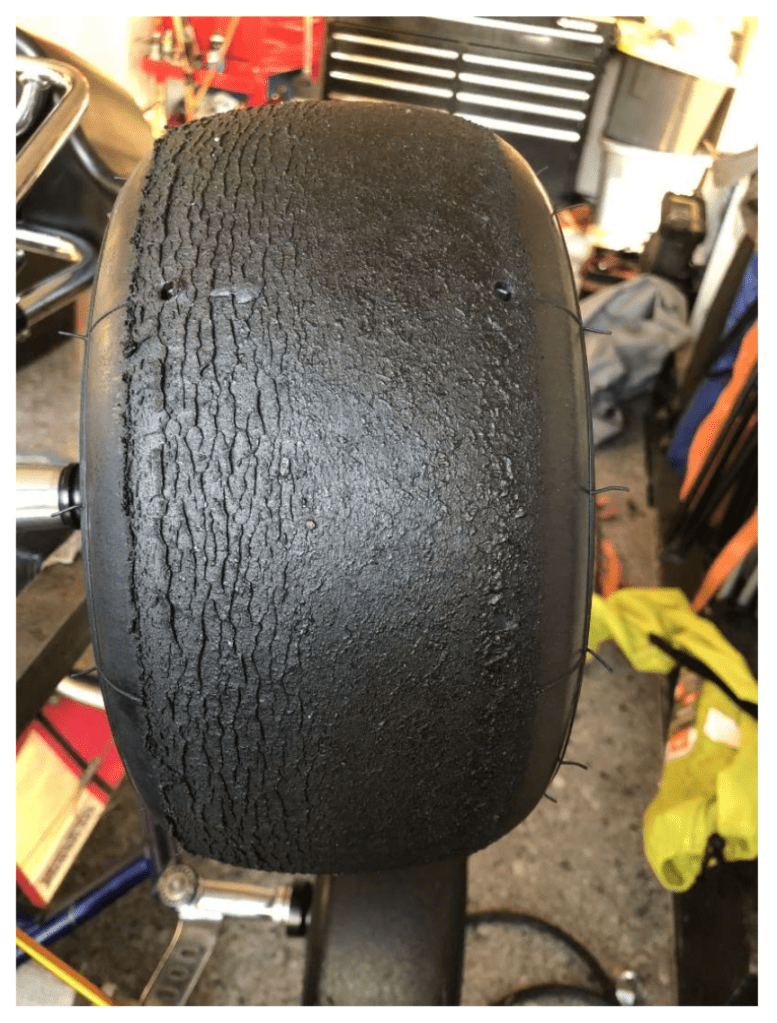
It is the most common surface degradation since it is also the wear of the tire. Technically, graining occurs when a brand new tire is exposed to a massive loads or to an excessive lateral slip angles (α) too soon. There are other causes, for instance, when the tire is too soft for the track asphalt. Hence, graining (Figure 1) occurs when too much heat is generated when the tire is new, which means a thicker thread. This means too much thread distortion and heat, then some strips of rubber begin to be torned away from the tire, but can also be re-attached to it. Another interesting point, is that the orientation of the grain strips give a clue of α which the tire was submitted. Graining can occurs both at cold and hot tire conditions. The first case results in graining, because the carcass is too cold, thus in a fragile condition. When the thread is too hot, the temperature is higher than the bulk temperature. Usually, a hot graining is caused by a wrong car setup, for instance, an excessive camber or too soft tire. The strips after was torned out are left on the track. Since they are at very high temperature, they are still sticky. Hence, when other cars runs over strips, these became bonded on their tires. Actually, strips left on the track are called, marbles.
Blistering

Blistering (Figure 2) is a more severe damage than graining, because it occurs in two regions of the tire, at the belt and the thread. Actually, it begins in the interface between these two. The main cause of the blistering is the excessively hot thread, that results in a reversion to an undercure condition. However, this can also be an indication of a construction problem. Another reason is an excessive high tire pressure, that deforms the thread and generates a great contact concentration at the middle of it. The aspect of blistering is like erosions on the thread, but these were air bubbles that explode. Blistering is an unreversible issue and the tire can not be used anymore, because it reaches the structural part of the tire, the belts.
Thermal degradation
Thermal degradation is a term that refers to the tire performance due to the operation outside the temperature range. Actually, the tire capability to generate friction and heat is connected to the thread thickness. As the thread is being consumed, tires looses temperature. Once this temperature reduces to a value below the lower limit of the tire temperature window, the grip obtained is lower. Tires must operate inside the temperature window to avoid overheating. Both operation conditions, at lower temperature or overheated results less grip generation.
Chemical degradation
The chemical degradation in tire are so relevant, becaue tires have an expire date. Race tires are even more critical in terms of aging, they must be used as soon as possible and must be stocked properly. Actually, any contact of these with the sun light results in the acceleration of the aging process, as the tires still are under the vulcanization process. Aged tires are tested at the field to verify its hardness. As hard the tire, more aged they are. However, the hardness measure of the tire at the field has a different reason to the same procedure in site laboratory. This one define the type of rubber applied in the tire manufacturing, more hardness results in a less grip that the new tire will develop with this rubber.
Debris on the track

Some engineers use to claim that tires are operated in a cloud of marbles or debris. Actually, when a race tire is being used, the temperature reached makes it be sticky. Hence tires during a race are always picking-up marbles, they became bonded in the thread and can have an effect on grip. Marbles (Figure 3) are hot pieces of rubber that are dettached from the tire due to graining. When another tire rotates over them, some marbles are collected. Usually they do not result in significant grip change, but in the past, when many racing series usually have more than one tire supplier, marbles are from tires made by different chemical compounds. Hence, a grip variation was felt by the driver. Actually, this could be intentional, since the amount of debris depends on tire chemical composition. Tire manufacturers can intentionally produce race tires that dettach too much marbles to reduce the performance of the competitors that use another supplier. On the other hand, a tire manufacturer can develop a tire with a chemical composition that is incompatible with the competitor tire chemical composition. Hence, marbles will not stick in their tires.
Marbles
During a race it is common to observe a patch over the track. Usually this one is a dark line over the asphalt. This is composed by the rubber that each lap is left by tires due to the friction between them and the asphalt. This patch develops a higher grip than the lines outside the dark area, because the rubber left by tires practically bonds on the ground which enhances the grip. However, there is another part of the tire rubber which can be found on the track, this one is even more visible, the marbles. These are tiny parts of rubber whose are detached from the tires during racing, they usually concentrate outside the track path. As they are left at high temperature, they bond on the surface. However, differently from the rubber on the path, marbles are big, usually 2 to 5 cm. In some racing series, marbles are not so visible, because the amount left by the tire is low. In fact, some tires do not leave to much marbles, these one are usually considered hard. In other words, tires which produces a higher grip usually leave too much marbles, that can be observed from the expectator. Actually, the amount of marbles are connected to the chemical composition of the rubber in the thread, with a low amount of carbon black. In racing field, it is usually said that drivers runs in a “marbles cloud”. This term was given, because when a tires run over marbles, the tire temperature makes marbles be glued on it. This may have two effects, an imperceptible grip increasing or, the more common, a subtle loss of grip which usually results in an accident.
References
- Haney, Paul. The Racing & High-Performance Tire – Using the Tires to Tune for Grip & Balance. TV Motorsports, SAE, January, 2003.
 Automotive Papers