Race tires are completely different when compared to road ones. There are many industrial secrets inside race tire structure. However, the impact of race tires in vehicle dynamics is huge. This occurs because these tire have compounds carefuly choosen to develop the highest grip possible. However, which axle should reach the peak of grip first ? Some comments about this question are made in this short article.
Balance
Balance is a generic term for the vehicle behavior. Actually, this term is largely used in the Motorsport field since there are some types of balance. For instance, aero balance, which describes the ratio between downforce at the front and the rear wings. However, in most cases the term balance refers to the car balance. During a corner maneuver, the driver rotates the steering wheel, the front tires steer developing a steer angle δ and a slip angle α. As this last one is produced, the tire produce a lateral force Fy. The chassis rotates about its center of gravity Cg at the Z-axis.

The result is a yaw moment that produces a slip angle αr on rear tires, thus a Fy2 at rear tires is also produced. Since the front and rear lateral forces are at a determined distance from Cg, they create torques that balances these forces. Hence, the total contribution of these forces are combined at Cg, which is the total lateral load. What defines the balance between the front and the rear axles is the magnitude of Fy1 and Fy2, which are in function of α1 and α2. Therefore, the relation between α1 and α2 is the car balance, or just balance.
Oversteering and understeering
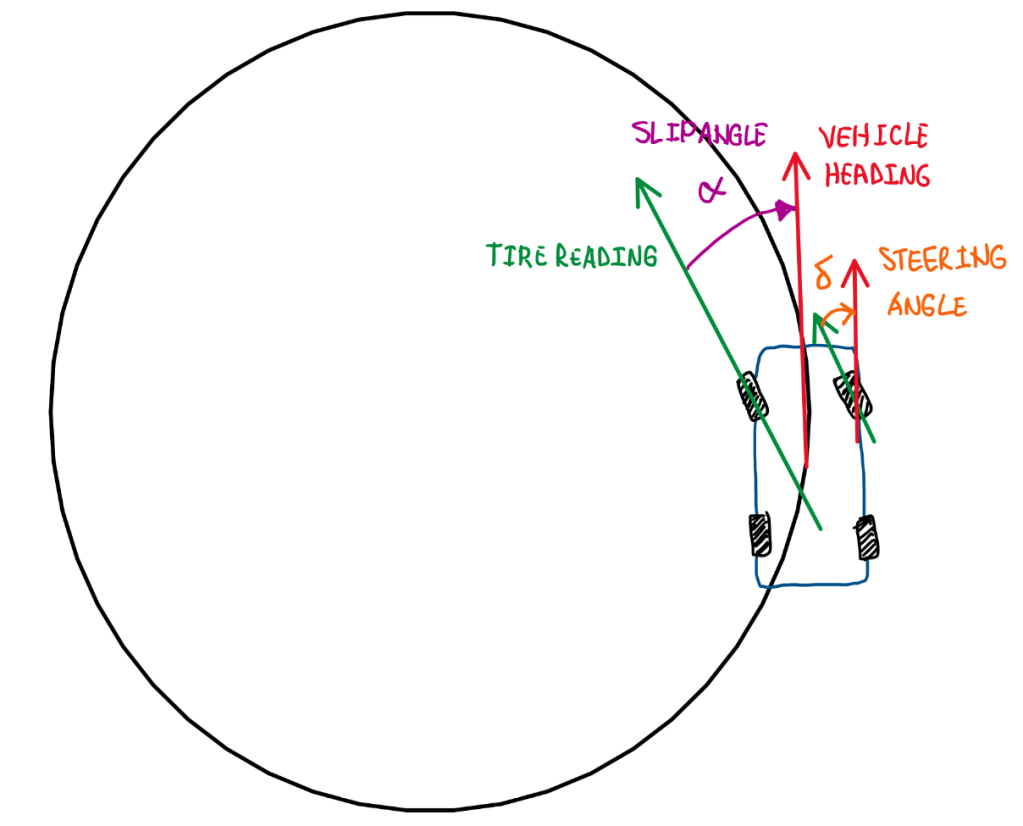
The best way to understand these two basic concepts of the vehicle behavior is through the steering pad test. This consist of a circular path that the car should travels at constant speed. Once the car is stabilzed, the speed is increased and the vehicle response is evaluated. There are three possible results:
- Neutral steer;
- Understeer;
- Oversteer.
The first occurs when the vehicle accepts the speed increasing without any variation of δ. In addition, α1 and α2 are equal, thus it is said that the car is balanced or neutral. The understeer behavior occurs if, for a higher speed and constant turn radius, the car asks for more δ.Hence, higher α1 is developed. The lateral force and slip angle at the front are higher than the same for the rear axle. The oversteer behavior is characterized by δ reduction for a higher speed and same turn radius. Hence, rear tires develop higher slip angles and lateral forces than the front tires. The problem of the oversteering is that the front tires tends to follow the rear slip angles, thus making the car promptness to perform a sharper turn radius. For this reason, the driver should apply less steer inputs or steering corrections.
Consequences of imbalances
The main problem of imbalances is that one axle is reaching an exaggerated α, higher than the one at neutral steer. In an understeering case, the higher slip angles required at the front axle result in more induced drag. Since this arise together with α, the car will be slower at a particular kind of corners, the engine-powered ones. The main characteristics of these corners is that they are traveled at full throttle. For instance, tamburello before Senna’s fatal crash. However, the most important condition is observed in ovals. An understeering car at these tracks, despite its stability, it is slower due to the high induced drag produced. The fastest car in oval tracks are the one that behaves at neutral steer.

A neutral steer car balance behaves as suggested by Figure, both axle tires reach the peak at the same condition. This also means that both axles produce the same α and Fy. As a results, the total lateral force produced is the maximum tire capacity. This is the best case.

Understeer behavior occurs when front tires develops higher slip angles than the rear ones. In addition, they reach the peak of the lateral force first. Hence, the total lateral force is lower than the neutral steer condition. The problem is that during the corner, the steering angle is so high that when the rear tires reach the peak, the vehicle suddenly goes from understeer to oversteer. This is called snap oversteer, usually occurs at corner exit when the turn in and middle corner were traveled at an understeer condition.

The oversteering behavior occurs when the α1 is higher than α2. The lateral force at rear axle reaches the peak first and the car enter in the oversteering behavior. Both understeer and oversteer behavior produces lower total lateral force than the neutral steer condition. However, only understeer can result in a sudden behavior change. The oversteering car tends to force front tires to follow the rear slip angles, which makes the car travels a sharper turn radius and then, spin out.
Reference
- Haney, Paul. The Racing & High-Performance Tire – Using the Tires to Tune for Grip & Balance. TV Motorsports, SAE, January, 2003.
 Automotive Papers