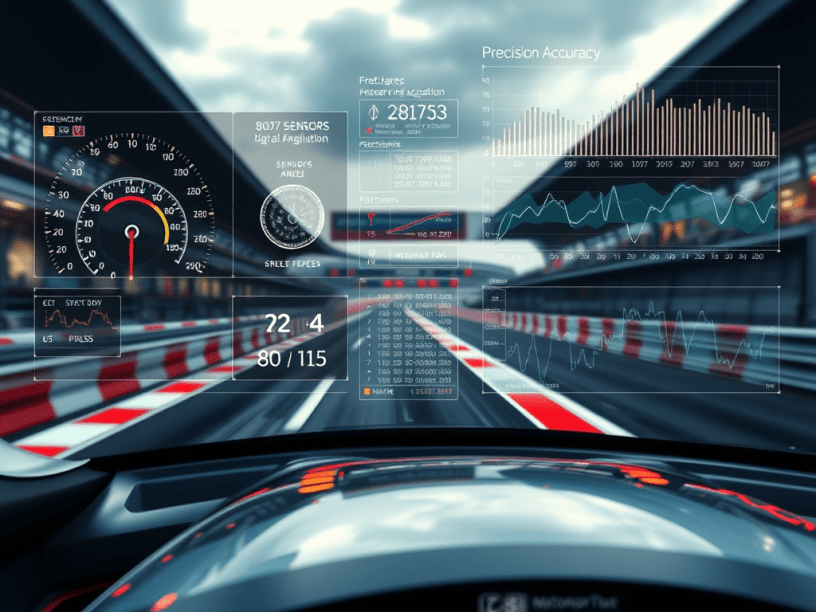
The three basic elements for data analysis are precision, accuracy, and resolution. This last one is defined also for analogical values, thus more information can be captured. The analogical values usually are position and time. Resolution is a digital element of the data analysis. The effects due to a reduced logging frequency allow us to spot some points that a higher frequency does not. Actually, there are benefits for increasing and decreasing sampling frequency. However, the main point is to understand that data acquisition systems have a fixed and limited memory. Hence, it is not possible to log every channel with a high logging frequency. Therefore, the nature of the phenomena should be understood in order to log it properly. For instance, there is no reason to log the coolant temperature with a high logging frequency. The same can not be said about throttle speed.
Sensors
The basic toolkit for data acquisition system is composed by six sensors. These are the speed, the steering angle, the throttle position, RPM, the lateral and the longitudinal acceleration sensors. The time and distance are measured by the beacon.
Lap distance consistency
The time is zeroed every time a car pass through the beacon. The distance is obtained by the division of the speed by the time. However, the car speed is not the traveled speed, because in a lap occurs slip angles, wheel spins, and locks. Hence, if it is only used the car speed to account the lap distance, this will be different at each lap. An interesting approach to evaluate whether many wheel locks or spins occurred is the lap distance consistency.
Oval tracks
This is an important parameter, particularly in oval race tracks. In this case, the lap time consistency is a sort of index that indicates the quality of the race line performed by the driver. The objective is to race in a minimum lap distance with a minimum amount of understeer. This the rule to be fast in ovals since understeer requires more steering angle. Hence, the tire scrubs the surface absorbing engine power and reducing car speed. A good car and driver are the ones able to run as fast as possible with a minimum understeer and on the inside line. For instance, when it is improved the car downforce, it is reduced the slip angles, thus the car can go faster through corners. However, this downforce comes at cost of more drag, thus the car speed is reduced. The car is lower on the straights. Hence, in oval tracks, the car should be able to be driven flat through corners. Then, this should come with the least amount of understeer that the driver can coup with. The last point is to refine drivers rather than the distance. Therefore, the time is obtained by the beacon and the distance is calculated. The beacon could be one per team or the time beacon is the same for all teams. In this case each has a transponder, thus an unique beacon for many of it.
Resolution
An important topic related to the sensor toolkit is about the vehicle model adopted. For this, the understanding of what is input and output is vital. For instance, throttle and steering signals are inputs, while RPM, speed, Gy and Gx are outputs. The resolution usually has a maximum of thousand data per second. The typical resolution of the sensors is summarized in Table 1.
| Data | Resolution | Full Scale | % |
| Speed | 0.10 | 100 m/s | 0.001 |
| Gx | 0.01 | +/- 5G | 0.001 |
| Gy | 0.01 | +/- 5G | 0.001 |
| Throttle | 0.10 | 100% | 0.001 |
| RPM | 30 | 15,000 | 0.002 |
| Steering | 0.10 | +/- 360° | 0.002 |
For the case of speed, the resolution should allow to record 0.10 m/s, thus the percentage (resolution/frequency) 0.001 is the usual value. A typical race car is able to develop accelerations about +/- 5G, thus the lateral and the longitudinal accelerations (Gy and Gx, respectively) have a resolution 0.01 G. These are very important parameters for vehicle behavior. Hence, it should be able to spot very small variations. Different resolutions are seen for throttle, RPM and steering since these parameters have different nature. These do not require a too high resolution. These are the basic parameters.
For instance, the damper loads are measured by strain gauges on the damper upper fixture. The anti-roll bar loads are measured by strain gauges on the tube. This allows it to detect torsions to the tube. The steering column torque is measured by a strain gauge on the steering column. The brake pressure is measured by pressure sensors on the circuit. The ride height can be measured by lasers on the corners of the car. The vertical G is captured by accelerometers. The speed sensors are deeply understood on the automotive field. The better solution is usually to have 4 sensors in order to monitor each one during braking, traction and cornering. The multiple vertical and Gy are measured by accelerometers on the sprung mass, one at the front and one at the rear of the car. A further sensor type is used for the engine and the fuel injection system. Most of them are common in road cars except exhaust temperature and crankcase torque. These are used according to the racing series technology level. Neither all racing series have this level of the data analysis.
Setup
The sensors should be well assembled, but this depends of the sensors characteristics and the nature of the measured signal.
Speed sensor setup
For instance, the wheel speed sensor is usually mounted on the outer front wheel. The reason is the smaller slip and lock effect that this wheel is submitted. Usually there some criteria to define where to install this sensor. First, verify if the race track orientation is clockwise or anti-clockwise. Then check on the database the chances of brake locking on corners. This can be verified by the lap distance consistency.
Accelerometers setup
Another important sensor that should be carefully installed is the accelerometers Gy and Gx. Usually, for race cars, it is mounted close to CoG, at about 30 mm distance from it. In addition, these sensors should be installed in a completely flat position.
Steering sensor setup
In the case of the steering sensor, there are two common approaches. It can be mounted on the steering column or at the steering box. The difference is that the sensor at the steering column is focused in to measure the driver input. In the case of the sensor mounted at the steering box, the objective is to monitor the wheel steering. The difference between these two signals is the backlash and play of the steering.
Throttle sensor setup
This principle of the steering sensor is also applied to the throttle sensor. Usually, there are two sensors, one at the gas pedal and the other at the throttle body (TBI). The signal of the gas pedal is normally preferred since it measures directly how much the driver is stepping the gas pedal. However, the signal of the gas pedal does not means that the throttle value is opening at the same amount.
References
- This is article was written based on the lecture notes written during the Applied Vehicle Dynamics lectures attended at Dallara Accademy;
- Segers. J. Analysis Techniques for Racecar Data Acquisition, 1st Edition. Warrendale, PA. SAE International. 2008.
 Automotive Papers