Composite materials are described by two definitions, micro and macro mechanical characteristics. The first one states the laminate properties as volume fractions of the matrix and fibers. A material should have its stiffness defined and this is the objective of the micro-mechanical properties. This process is quite simple for unidirectional laminates, because all plies are in the same directions. Hence, in the case of laminates in different directions, each laminate must be properly characterized. In other words, the definition of different laminates and their stacking sequence in order to build the stiffness matrix of the entire laminate. The unidirectional laminates are barely used in the motorsport, for this reason the following articles will describe mostly multidirectional laminates.
Hence, it is necessary to understand that, usual laminates are defined in terms of ply orientations. The fibers are disposed at different angles. This is a sort of transition step between micro and macro mechanics, because it is started by the analysis of a single constituent (fibers and matrix), their properties and amounts, while the prediction of the laminate behavior considers the different orientations of each layer. The laminate or lamina constituents are the matrix and fibers. This one is the component that provides the partial mechanical properties of the laminate. Fibers are responsible for the mechanical stiffness, the load support and, at majors influence, the laminate resistance. Another important aspect regarding fibers is the deformation control. All those aspects are strongly dependent on the load direction. In terms of matrix, its main function is the load transference between fibers. This is what makes composite materials work properly. In addition, the matrix is also responsible for fibers protection against external agents, humidity and intrusions. Usually, the matrix is tested in order to evaluate its capability to transfer load. Another two important aspects regarding matrices is that they deal with the laminate toughness and fatigue resistance.
Heterogeneity, anisotropy and orthotropy are desired characteristics in composite materials. The first states that different positions of the laminate exhibit different mechanical properties. In other words, the mechanical properties are a function of the position along the laminate. The anisotropy defines that, the mechanical properties can vary if the material is loaded in parallel or orthogonal to the fiber direction. Similarly, the orthotropy is a laminate property which states that, the composite material properties strongly varies according to orthogonal directions.
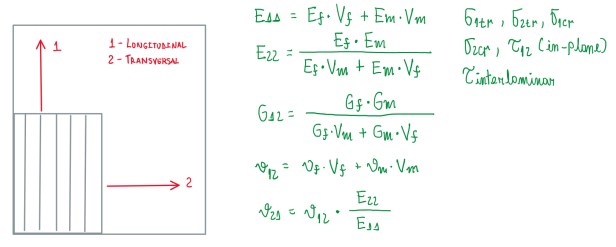
The engineering constants are defined according to the principal material directions. This the direction respective to the fiber orientation, usually defined as the longitudinal direction. The direction 2 is called transversal one, it is orthogonal to the fiber orientation. This is the basis for the definition of the engineering properties as Young’s modulus, shear modulus and Poisson’s ratio. Hence, it is possible to fully characterize the material when longitudinal, transversal, shear and interlaminar stresses and at the plane parameters are defined. They are estimated by experiments that use loads and deformations to find the strain.
References
- This article was based on the lecture notes written by the author during the Design of Composite Structures for Racing Cars attended at Unimore.
 Automotive Papers