
After understood the main aspects of the mechanical characterization and its importance for composite materials design, the proper way to test these materials is the next step. Basically, mechanical testing must correctly performed to extract the material performance. This article proposes a summary of the main tests, their configurations, machines and factors that affect their results.
Mechanical testing
As the name suggests, mechanical testing machines are used to perform tests on the samples. Usually, those machines are split in two groups, the electromechanical and the hydraulic ones. Despite the operational principles, the main differences between these two types is the kind of loading that they can apply. Electromechanical testing machines are only able to perform statistical loading, because they work based on never ending screws. On the other hand, the hydraulic machine can apply both, statical and dynamical loading. The reason is that the hydraulic circuit is able to create a wave pattern loading, thus allowing it to evaluate the fatigue of the samples. The electromechanical testing machine is based on never ending screws and a cross-head that moves through them. This also has the grips that fix the specimen during the test, they are electromechanical, magnetic or hydraulic. This testing machine is a very strong rig, thus it must be well fixed on the surface.
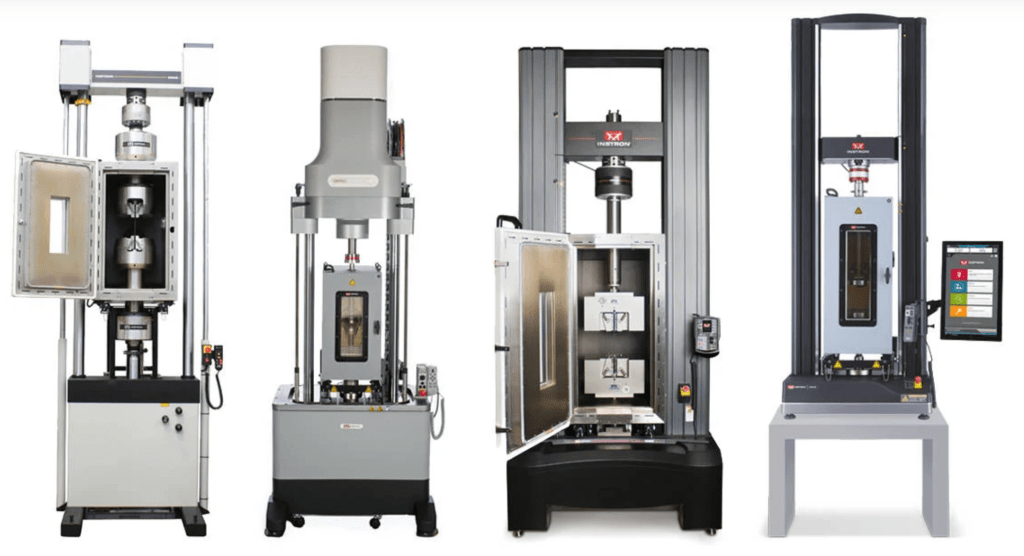
They are capable of performing tensile and compression tests. The specimens are evaluated by liner variable displacement transducers (LVDT) and strain-gauges. Actually, the first is a transducer for the cross-head movement monitoring, by measuring its displacement. The strain-gauge measures the deformation on the specimen, which can be performed axially or bi-axially. These measures are done in one or two directions, respectively. This method is useful to directly calculate the Poisson’s ratio. However, there is also a method that uses load cells. These measure the loads and, consequently, the stress. Together with LVDT, it is possible to build the stress-strain curve. The hydraulic based machines are similar to electromechanical ones with respect to the cross-head, which is movable and fixes the specimens. A hydraulic circuit with proper valves is mounted at the back of the machine. This kind of machine is capable of creating load history and a series of events. Actually, this machine is able to perform static, quasi static and dynamic experiments. These aspects allow those machines to evaluate not only tensile and compression, but also fatigue, since it is possible to combine different loading and frequencies. Therefore, electromechanical machines are dedicated to static tests, while hydraulic ones are more indicated to fatigue tests.
Experimental configurations

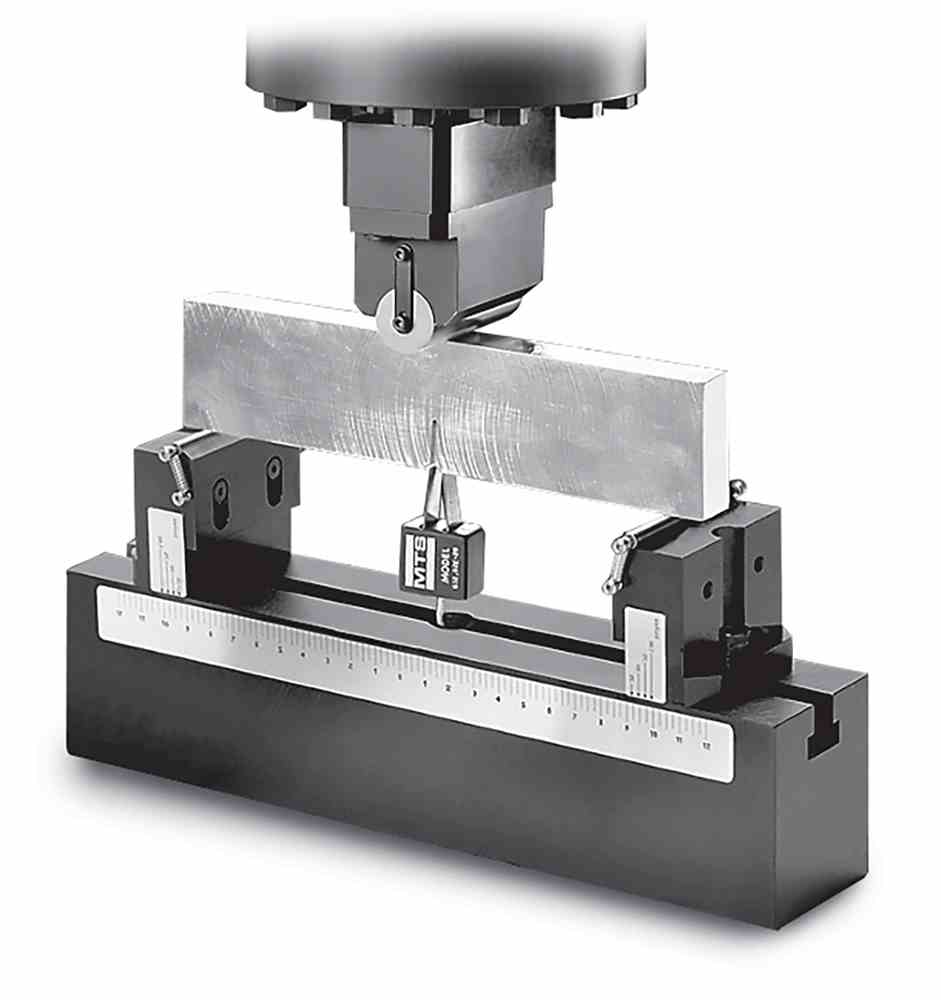
The mechanical testing has three main configurations, the tensile, the compressive and the three point bending ones. The difference between them is what they evaluate. Usually, the first two are performed to evaluate the matrix and the fibers. The three point bending evaluates the flexural properties and the interlaminar shear stress. In other words, two types of evaluations on the same configuration. The flexural properties are obtained by testing a rectangular plate specimen under three point bending. Once the proper span is defined, the test can be performed. The effect is a compression and tension at the upper and bottom parts of the specimen. The flexural properties are obtained once the stress at break is obtained, this usually is observed at the compressive portion. The interlaminar shear stress is obtained by measuring a short pin under the three point bending. The thickness to length ratio and the span length allows us to evaluate the interlaminar shear stress of the laminate. The material is submitted to a three point bending with a 25 mm span. Actually, this test simulates a sort of delamination. In addition, since the specimen is being loaded orthogonally to the fiber direction, fibers are being evaluated instead of the matrix. This test laterally evaluates the delamination through the fracture toughness capability of the matrix. A higher fracture toughness of the matrix results in a lower delamination incidence and occurrence of openings in the laminate. Regarding the tensile and compression tests, both evaluate the fiber and the matrix stability. The flexural properties are very connected to the Young’s modulus of the material. The results of the three point bending are useful for FEM analysis in order to serve as data check with respect to the material chart.
Factors affecting mechanical tests
The objective of the mechanical characterization is to build a proper technical sheet of the materials. This is a database that has all the material properties and behaviors at the main directions with respect to the fiber orientation, 0°, 90° and 45°. The problem is that, there are some aspects that affect the test results, this is the correct mechanical characterization. Regarding materials of the specimen, the main factors are porosity, fiber content and matrix weight. The problem of porosity is that it represents a lack of material. At some degree, this certainly affects the mechanical properties that were registered after the test. A porosity problem can reduce the interlaminar shear stress by 30%-40% with a few percent of porosity. If a laminate of 40% in weight of matrix is being analyzed, any problem with its matrix will have a significant impact on the results. The lay-up is another factor, because laminates can have different properties according to the laminate. The DMA and DSC tests can also perform mechanical evaluations, but in those cases they work with coupons. Then, they become another factor that affects mechanical tests. In terms of coupon materials, if they have different fiber – matrix content with respect to the data sheet, for instance low matrix, the results can be biased towards low mechanical properties. Then being out of range expected for the data sheet. Actually, coupons have several factors such as weight, thickness, diameter, length, span and conditioning. This last one has a direct impact on the coupon of a sample. It changes the results since conditioning alters the coupon properties to emulate and to test the material under specific conditions. For instance, the evaluation of coupons for marine applications since the fibers are very hygroscopic. The coupon state also interferes with the results. A proper visual check against damages can avoid problems related to that. Actually, tests have several factors such as conditions, fixtures, load alignment and testing speed. The test conditions which are most important are humidity and temperature. Especially this last one, because they are capable of affecting the sample damage. In other words, the sample will be damaged in different ways with respect to reality. Usually, load alignment with respect to the fiber direction can result in a momentum capable of damaging the specimen in shear.
References
- This article was based on the lecture notes written by the author during the Composite Materials course attended at Muner;
- Sintom Website;
- Instron Website;
- MTS Website.
 Automotive Papers