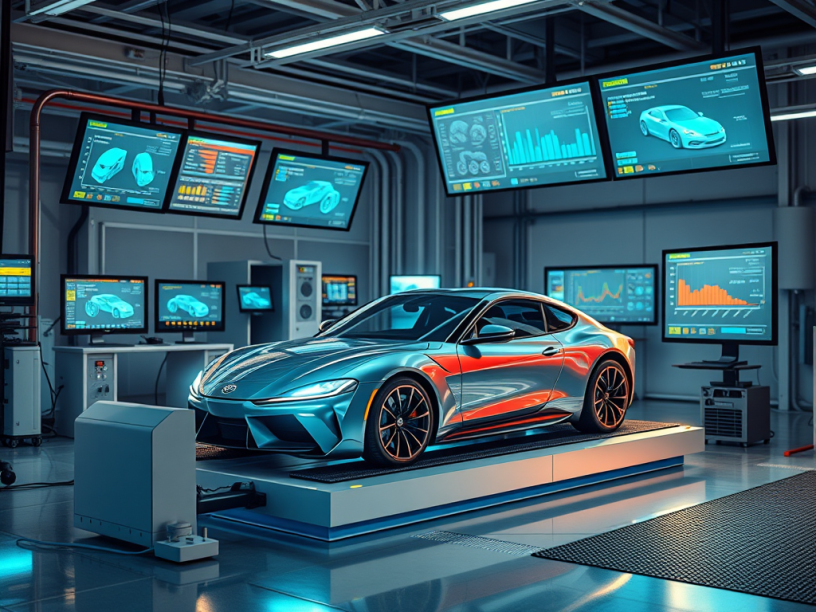
The indoor testing is a method to characterize real and built vehicles models. It is possible to test a vehicle before and after it is built. The simulation is a tool to test a vehicle in a virtual environment. A virtual model comes before the real car, thus it is applied into the designing loop. The real model is built and tested and the results are used to refine the virtual model. The data acquisition for a virtual model, since there is no previous vehicle, is the simulator itself. In some literature this term is substituted by driver in the loop DIL. The procedure to retrieve data from a new virtual model consists of a certain amount of simulations and their outputs are the data. These could be the torque on the driveshaft, the loads on the suspension, the push-rod loads and any forces resultant from driver and external inputs.
Vehicle dynamics and testing
There are two important definitions that are often misunderstood in the literature, testing and measurement. Testing is a process of performing a function in order to verify if it works properly. Measuring is a quantitative process, is a checking of function results. Usually, size, force or pressure are parameters which are measured. In a virtual model testing it is necessary to make some assumptions. These can be the weight, power and aerodynamic loads of the car. If the hypotheses are incorrect, the output will likewise be erroneous. The measurements must be meaningful and repeatable. These are characteristics of the virtual environment, not the real one. In the virtual environment, the same input will return the same output. It is a regulated environment in the sense of it motivates a higher analysis and measurements precision. The data produced by the simulator is validated from other data or measures.
The virtual model actually is a mathematical one, which is characterized by its readiness for using. It could be a simple or a complex model and this decision is connected to the project budget. Actually, any virtual model has an allowable output range. The narrower the range, the higher the output precision, but the higher the model complexity. Hence, one can observe that this is a matter of uncertainty reduction. However, if the assumption, in a very complicated model, is misunderstood, the outputs will be completely far from the expected. This means that a very complex model does not imply an accurate output. Therefore, a virtual model should be improved, but when this means more complexity, it should be done only when needed. The track testing has a lot of non-controlled variables as track and driver conditions. The virtual testing is the opposite.
The population of the virtual model regards the amount of input data for different scenarios, which can be a race track, downforce level or vehicle power. Hence, it is a scan of a wide range of multiple scenarios. It is a solution to have large boundaries of the situation. Finally, when the real car is built, the data will be more refined, then the model population will be more specific. After that, the results are correlated. Actually, correlation is a process that follows three steps: observation, theory and checking. However, if the checking is erroneous or does not match the observation, the theory was wrongly defined. This suggests that the virtual model is not adequate. These two approaches represent a work method focused on theories and realities, respectively.
The second approach is more practical, it is guided by the effects on the track. The term complexity comes from complex, which is similar to complicate. According to Professor Andrea Toso, these have suffixes -plico and -plex. The first one is Latin and means fragmented in many details. The suffix -flex means a tissue, a fabric that has correlations between one and another variable. Therefore, the virtual model is selected in order to be very complex, but not complicated. The model should be simplified until a point that it is still manageable and retains the essentials of the problem. It captures the essence of the problem. Whether this is not identified, the virtual model should be refined or there is missing information.
Method with caveats
The term method comes from latin meta + odos, which “meta” means an intuition while “odos” means road. Hence “meta + odos” a guide to a road, a step by step process, thus method is an iterative process of proceeding or performing something systematically. The method is based on a hypothesis, measurements and on the mathematical model. This is basically the second approach described previously, where the theory is the hypothesis, an assumption that justifies the fact, but unproven. The measurements are reality checking and are the practical part of the method.
The mathematical or virtual model is the initial theory refined by the information seen in the real environment, on the measurements. Assumption and hypothesis are two different concepts. The first is based on beliefs, principles and axioms. The hypothesis could be predicted, refined, contributed or changed. Hence, it is supported by reasoning and measurements. The assumption is unmeasurable and does not require verification. The hypothesis needs to be validated or rejected. Therefore , a method means that, always there is an idea of the expected results, cross-correlations with other activities should be done, the activity and the partial results should be controlled, unexpected results must be investigated and the process reviewed even if they are correct and fit the expectations.
Testing objectives
A typical design cycle in racing field is composed by the virtual and the real environments, which complement themselves. The cost increases exponentially in the physical world. The early decisions set the following ones at mature stages of the process. Hence, the early decisions may not or may be more than expected. Apparently, these decisions do not cost much, nevertheless in reality they can cost the entire project, because the personnel involved follow the target and become more and more constrained. Hence, the early decisions are the most expensive ones since they determine the main design target. This is the reason why the virtual testing is performed early on. The cost of defects increases a lot as the process is becoming mature. Money is spent when parts are made and operated. For those costs, the test is a constant task in vehicle design since it helps to find issues before the end-user, to improve safety, durability, performance, confort, nvh, to homologate and access the vehicle build quality before releasing cars to race teams. Finally, testing reduces the risk since it is impossible to cover everything.
The cycles of a prototype during the design process have an evident objective, to spot problems and re-design parts. Since it is not possible to test everything, the focus is to test towards the highest risk components and systems. The testing interaction is the real environment, the virtual testing uses the model to populate the model with different scenarios. Then, the part is redesigned, is virtual modeled and simulated again. Finally, a re-designed part is built as proto and tested in a real environment. This test is limited due to a huge amount of time spent in virtual testing. If the hypothesis is confirmed, this means that the model is validated. In addition, if the virtual world is a good representation of reality, then the virtual model is correlated to reality. Virtual testing is to reduce the development time, to get answers to support decisions, to reduce time to marketing, to reduce problems even in physical prototypes and to reduce time to recover from problems and mistakes. Finally, it allows us to obtain better results in comparable time. This also means better understanding and results.
References
- This article was based on the lecture notes written by the author during its MsC at Muner/Dallara Academy.
 Automotive Papers