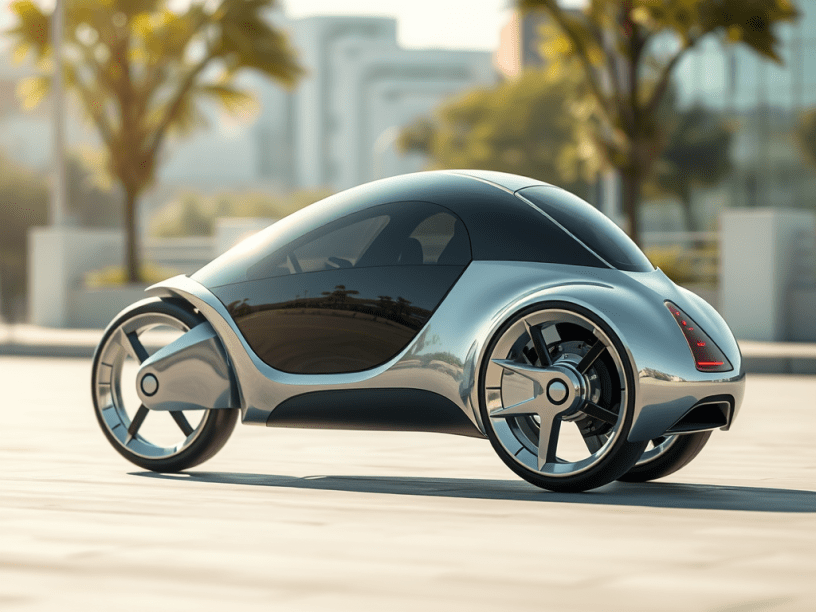
A solar energy powered vehicle has a streamlined body and three wheels partially hidden by the vehicle body. The downforce coefficient is CL = 1 and the vertical loads are equally distributed over those wheels. The vehicle mass is m = 480 kg, the frontal area is A = 1 m², the lateral friction coefficient is μ = 1, the gravity acceleration is g = 10 m/s². The velocity profile of the car respective to the longitudinal plane is given by the following equation:
(U(η)/U∞) = (η – 1)³∙(η + 1) – β(x)∙η∙(η – 1)³ + 1 ; η = z/δ(x)
Where z is the vertical coordinate normal to the vehicle body, δ(x) is the boundary layer thickness and β(x) is a decreasing function of x, that accounts the evolution of the velocity profile.
Question 1 – Calculate the minimum curvature radius when the vehicle velocity is U∞ = 10 m/s²
There are two important aspects when analyzing the vehicle capacity to go around a corner, one is the tire performance, the other is the aerodynamics. Actually, tires depend of their contacts with the surface. Since this vehicle has an aerodynamic bodywork, the friction coefficient gives place to the aerodynamic rigidity Ka, which is given by Ka = – q∞∙A∙∂CZ/∂h, thus it is a function of the vehicle ride height, frontal area and the dynamic pressure. Actually, this aerodynamic stiffness depends on velocity, because the dynamic pressure is velocity dependent. Although ∂CZ/∂h also is velocity dependent, this proportion also is connected with other parameters. For instance, suspension stiffness. Therefore, the calculation are more simpler.
q∞ = ½∙ρ∙U∞² = ½∙1.2∙10² = 60 Pa
μ∙(m∙g + L) = m∙U²/R → R = m∙U²/[μ∙(m∙g + L)]
L = q∞∙CL∙A = 60∙1∙1 = 60 N → L = – 60 N (Downforce)
R = 480∙10²/[1∙(480∙10 + 60)] = 48000/4860 = 9.877 m
In these calculations it was possible to notice two equations to calculate the lateral force in a vehicle, [μ∙(m∙g + L)] and m∙U²/R. This last one is the component defined by the vehicle dynamics and geometry. So this is the limit that the car is not able to overcome. Hence, the first component should be equal or lower than the geometric limit. Finally, it is observed that there is a maximum curvature radius that the car can go. Another conclusion is that this car has a streamlined bodywork, that produces a small lift (downforce, in this case), but it still has some impact in the vehicle cornering capability.
Question 2 – Calculate β(x) at the separation point
In this case it is important to understand how the flow behaves over streamlined body. Considering the following equation, valid for wing profiles under ground effect and low attack angle α:
CL = 2π[1 + (c/4h)²]α ; α [rad]
The point is, the position that separation occurs is given when the velocity gradient is vanished at the wall as described below:
∂u/∂y = 0 ; for (xS , y = 0)
Therefore the following procedure is performed:
U(η) = U∞[(η – 1)³∙(η + 1) – β(x)∙η∙(η – 1)³ + 1] ; η = z/δ(x)
U(η) = U∞[(z/δ(x) – 1)³∙(z/δ(x) + 1) – β(x)∙(z/δ(x))∙(z/δ(x) – 1)³ + 1]
U(η) = U∞[(z²/δ(x)² -2z/δ(x) + 1)∙(z/δ(x) + 1) – β(x)∙(z/δ(x))∙(z³/δ(x)³ -3z²/δ(x)² + 3z/δ(x) – 1) + 1]
U(η) = U∞[(z³/δ(x)³ -3z²/δ(x)² + 3z/δ(x) – 1)∙(z/δ(x) + 1) – β(x)∙(z/δ(x))∙(z³/δ(x)³ -3z²/δ(x)² + 3z/δ(x) – 1) + 1]
U(η) = U∞[(z4/δ(x)4 + z³/δ(x)³ – 3z3/δ(x)3– 3z²/δ(x)² +3z²/δ(x)² + 3z/δ(x) – z/δ(x) – 1)
– β(x)∙(z4/δ(x)4 – 3z³/δ(x)³ + 3z²/δ(x)² – z/δ(x)) + 1]
U(η) = U∞[(z4/δ(x)4 – 2z³/δ(x)³ + 2z/δ(x) – 1) -β(x)∙(z4/δ(x)4 – 3z³/δ(x)³ + 3z²/δ(x)² – z/δ(x))]
∂u/∂z = U∞[(- 2∙4z3/δ(x)4 – 2∙3z²/δ(x)³ + 3∙2z/δ(x)² + 2/δ(x) – 1)
– β(x)∙(4z3/δ(x)4 – 3∙3z²/δ(x)³ + 3∙2z/δ(x)² – 1/δ(x))]
Since the condition for separation is the velocity vanishing at the wall, z = 0:
∂u/∂z = U∞[(– 2∙4z3/δ(x)4 – 2∙3z²/δ(x)³ + 3∙2z/δ(x)² + 2/δ(x))
– β(x)∙(4z3/δ(x)4 – 3∙3z²/δ(x)³ + 3∙2z/δ(x)² – 1/δ(x))]
∂u/∂z = U∞[2/δ(x)) – β(x)∙(- 1/δ(x))] = U∞(2/δ(x)) + β(x)/δ(x)) = 0
2/δ(x) = – β(x)/δ(x) → β(x) = – 2
As can be seen, β(x) = – 2, because this definition of separation establishes that it occurs just at the wall. The value of – 2 indicates that there is separation, since β(x) is a decreasing function that indicates a possible boundary layer separation. Hence, β(x) must be negative to occur separation.
Question 3 – Indicate the β(x) range which the pressure gradient of the boundary layer is adverse
This question proposes the definition of the range of β(x) which the pressure gradient is adverse. This is defined by the curvature of the velocity profile β(x), its sign is the same as the pressure gradient. Hence, to calculate β(x) which the pressure gradient is adverse:
∂²U/∂y²|w = μ-1∙(dP/dx)|w ≈ μ-1∙(dP/dx)
For separation, the pressure gradient must be adverse, which means that the condition can be written as:
dP/dx > 0
Hence, the calculations are:
∂u/∂z = U∞[(- 4z3/δ(x)4 – 2∙3z²/δ(x)³ + 2/δ(x))
– β(x)∙(4z3/δ(x)4 – 3∙3z²/δ(x)³ + 3∙2z/δ(x)² – 1/δ(x))]
∂²u/∂z² = U∞[(- 4∙3z2/δ(x)4 – 2∙3∙2z/δ(x)³)
– β(x)∙(4∙3z2/δ(x)4 – 3∙3∙2z/δ(x)³ + 3∙2/δ(x)²))]
Again, since these calculations are respective to the conditions at the wall:
∂²u/∂z² = U∞[(– 4∙3z2/δ(x)4 – 2∙3∙2z/δ(x)³)
– β(x)∙(4∙3z2/δ(x)4 – 3∙3∙2z/δ(x)³ + 3∙2/δ(x)²))]
∂²u/∂z² = U∞(- 6β(x)/δ(x)²) = – β(x)∙(6U∞/δ(x)²)
Since the conditions for the adverse pressure gradient are dp/dx > 0 and du/dx < 0:
∂²U/∂y²|w = μ-1∙(dP/dx)|w ≈ μ-1∙(dP/dx)
– β(x)∙(6U∞/δ(x)²) = μ-1∙(dP/dx) → dp/dx = – β(x)∙(6μU∞/δ(x)²) ; β(x) < 0
Therefore, β(x) should be negative, because U∞ and δ(x)² are positive quantities, thus the previous results of β(x) = – 2 is correct.
Question 4 – Calculate the attack angle for a chord c = 3.2 m and ride height h = 0.4 m
Considering that the wing is at ground effect and under low attack angle , the equation for the lift coefficient is given by:
CL = 2π[1 + (c/4h)²]α = 2π[1 + (3.2/4∙0.04)²]α → 10πα = 1.0 → α = 1/π10 rad ≃ 0.032 rad
Now it is possible to calculate the vehicle drag since αi = 0.06 rad. Assuming that the streamlined body of this car has a similar profile to an elliptical wing.

αi = CL/(πAR) → AR = CL/(παi)
CD,i = CL²/(πAR) = CL∙αi = 1∙0.06 = 0.06
Di = q∞∙c∙CD,i = 60∙3.2∙0.06 = 11.52 N/m
Finally, the downwash velocity component can be defined according to the induced angle of attack illustrated at Figure 1:
αi = arctan(-w/U∞) = – w/U∞ → w = – U∞∙αi = – 10∙0.06 = – 0.6 m/s
Conclusion
Actually, the main point of this question is the effect of the aerodynamics on the vehicle performance. As can be seen , by equation:
μ∙(m∙g + L) = m∙U²/R
The aerodynamic force L determines if the car can or can not go around a corner by the speed requested by the driver. The assumption made on this question just simplify the vehicle body into a streamlined body. However, cars and even race cars are considered blunt bodies, thus the form drag is more relevant. In any case, the equation above can be applied, but if the car is a blunt body, its wing are not. Hence the considerations about elliptic wing is the same as the ones applied in this exercise. Again, the values of the velocity and the pressure gradients define the flow situation, when the first is zero and the pressure gradient is positive, the flow is prone to separate. This is an extremely important condition to understand where the flow separates along the race car body.
 Automotive Papers