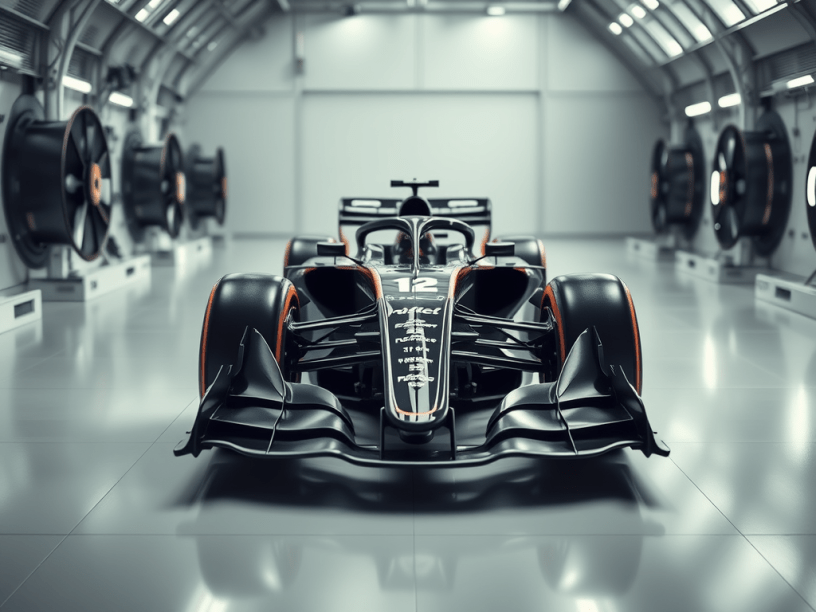
In Formula One (F1) it is required a particular condition when it is being considered the role of the aerodynamicist. Compared to other motorsports categories, the number of people involved in the development is much higher. The team needs to be quite focused in what to do in order to get the results. This article proposes a brief comment about the aerodynamic department of Formula One teams and their activities.
The aerodynamics department structure
The aero department is divided in aero development and aero operational groups.
Development roles
- Aerodynamicists;
- CFD methodology.
The first is more focused on the performance, the shape development, which means that to make the car faster it is required to analyze the flow. In other words, understand how to make the car quicker just looking the parts, their concepts and shapes, making sure that these attend the requirements of quality. The operational role positions are more focused on what can be useful. Their work is based in wind tunnel (WT) tests. This team should be very efficient in what to do to optimize the car in terms of key parameter indicators (KPI). For these, the operational team should know how to develop extra tools to improve the efficiency of the processes, thus the vehicle efficiency. Therefore, the aero department is focused in the maximization of the development, each head must understand its role, which means that each test should be very well planned and thought to avoid ideas or theories that does not work. The reason is that nowadays WT tests are time and budget limited. The role of the aerodynamicist is to understand the close factors of the car, to design the car in one or more conditions having the highest speed possible. To achieve that the engineer must understand data and to think in solutions. The CFD methodology develops the tools for the aerodynamicist tests the solutions proposed. Whatever is the solution chosen, it always requires some refinements and gaps for innovations.
Operational roles
- Aero surfacing;
- Model design;
- Model shop;
- Production;
- Technical buying;
- CFD tools.
In terms of operational roles, there are people focused on CAD and surface design. This called aero surfacing, skillful designers that also are good aerodynamicists. On the other hand, some aerodynamicists design surfaces that are refined by the aero surfacing personnel. Usually, they work closely and there is a close contact. People from model design are the one that works in the last step before WT. Once there are the surfaces and these were already tested in the CFD environment, these must be transferred to the wind tunnel model (WTM). The model design role basically translates the surfaces as parts to be assembled in WTM. Model designers are the best to built a CAD model in terms of quality and refinement. The model is assembled with different components, parts and materials. Most of the parts are printed components, but there are also metal parts, as aluminum or steel ones, in sections of the car that is more requested during simulations. In addition, carbon parts can be used when requested. It must have a compromise between design freedom, quality, and time to produce these parts. Model shop role is the preparation of these parts and assembling them together into WTM. The production role is the toughest part of the chain, because it always must guarantee that parts will be built at the right time or as fast possible. The technical buying role are people that develops tools for the highest CFD quality. The surface design is the start of the process since CFD became a very fast process. Hence, now is possible to have many interactions, because the process is responsive enough for it. The objective is to produce a surface which can be quickly modified in order to allow the simulation of different configurations. In addition, the surfaces must also be legal in terms of FIA regulations.
Computational fluid dynamics process
The CFD process begins with an initial mock-up to verify the car design and what occurs during the process. If the results make sense, the process can continue. However, the first analysis are usually negative. Some iterations are necessary to deliver reasonable results. Actually the process can vary, because softwares and wind tunnel models WTM can vary. The process starts with the case submission, the aerodynamicists and designers build the surfaces. Once it is developed the alternative, this must be first evaluated inside the CFD environment. For instance, a new front wing has a new flap as a design variation, which must be validated in CFD simulations. This means that this front wing is changed with a new flap by a tool that performs these simulations automatically. Automation is what makes CFD processes to govern the aero development, because through algorithms it is possible to execute several modifications and run efficiently. Once the simulation parameters are defined, the meshing and run is automated. This automation is basically a way to jump conditions and creating a post process according to the kind of output the designer wants and should analyze. For instance, a CFD post process dedicated to cornering ability of the car, thus the post-processes exhibit many information about the downforce in terms of the section of the front wing. Although the CFD process is automated, the refinement is user-defined.
F1 aerodynamic regulations overview
The FIA regulations for F1 aerodynamics define the constraints in this design area. The main constraints are the time limit for wind tunnel tests and CFD simulations. Although the process is well optimized and has the best tools, the time limitations requires an efficient process and also, decisions very well based in physic principles. The FIA controls time by the calculations report that indicates the computational time. In terms of WT tests, FIA checks all reports emitted after each WT section. However, each case requires different procedures. For instance, in CFD, different parts and components have simulations with specific configurations. Heavy CFD simulations are straight line, high and low speed corners. These are critical simulations, because there are several WT important parameters as steering angle, ride height, yaw angle and also DRS activation. Wind tunnel tests can generate much more data in a single run than a CFD one. However, only in CFD simulations it is possible to visualize the flow field or, at least, an estimation of F1 car flow field. This is possible, because in WT the environment is basically a rectangular box and the flow faced by the front wing is a bit limited respective to the real situation. The CFD domain is more faithful to the real condition. Hence, it is important to cross the information generated by both environments. Actually, their results are complementary. The wing angles are chosen according to the center of mass, the front and the rear axle.
Any vertical cross section of bodywork parallel to the plane C-C situated in the volumes defined in Figure 2 must form one tangent continuous curve on its external surface. This tangent continuous curve may not contain any radius less than 75 mm.
3.5.7 bodywork shape (R75) FIA F1 Rule
Figure 2 illustrates one of the many rules about the F1 aerodynamics. As can be seen, there are zones which the wings must be inside. The citation above, describes that any cross section parallel to the one at the plane at center of the car, but inside the volume described in Figure 2.
F1 aero tools and testing
WT tests are very good to tire force and pressure, but it is not possible to obtain the effects due to the engine exhausts. Hence, it is not possible to understand the heat rejection. For this case, CFD simulations are the only way to better understand the impact of the engine on the flow field. Sometimes WTM need some refinements, as inserts for fasteners that need glues in order to retrofit them during the test period. Hence, there is too much preparation, because WT time is expensive and limited by regulations. In addition, F1 homologated wing tunnels have enough lateral space in order to reduce wall effect on the wheels wake. There are specified dimensions for WT buildings. Another interesting point about F1 WTM is the tires. These are proper scale tires for wind tunnel models, which reproduce all the effects that a real F1 tire exhibits when under operations. The tire deflections results in effects on the flow field that goes through it. However, these tires details increase a lot the cost of a F1 WTM.
Since WT still are very complex, the ones from F1 and top class racing series are even more complex. It has a huge amount of sensors and pressure taps. These taps are placed in the same point that, in CFD environment there are pressure measurement. Hence, it is possible to cross information between those environments. In some F1 WT models there are systems that emulate the engine exhausts. F1 WTM also have active suspensions and moveable devices that adjusts itself with the wind. This last is mandatory by the regulation. Another point that makes F1 WTM so expensive are their components and materials. These are pushed to the limit in order to explore how thin some parts, components and wing profiles can go without break under high aerodynamic forces. For this reason, F1 WTM are the ones that most use metal and metal coated parts.
In terms of CFD simulations, F1 is the racing series that have the most complex CFD simulations. A F1 watertight model is usually discretized with 600 million elements. F1 constraints push teams to the limit so that they must improve their pre and post process in order to perform the highest number of simulations as possible. The problem is that F1 simulations must not only test several configurations and car movements, but all of these are unsteady configurations, which require big hardwares that ensures a high computation capability.
F1 trackside aerodynamics
The track test is basically a validation of WT and CFD processes, but the result can or can not exhibit a good correlation. These demonstrates the quality of the processes. The car at the test is instrumented with several sensors, for instance, push-rod cells, static pressure scanners, pitot and yaw probes, ride height lasers, suspensions potentiometers, slip angle sensors, brake temperature sensors, power unit temperatures and component deflections sensors. The objective is to perform a complete data analysis which the ride height, car speed, pressure, yaw, steer and roll are present. Hence, it is possible to verify how the car behaves under the main situations, which were already tested at WT and CFD environment. In this point, pressure taps have an important role.
Another important tool that track tests can allow are the aero maps, the ride heights are correlated with the lap times or between rear and front axle ride heights. The objective is to measure the wind speed. With this information it is possible to calculate the dynamic pressure, to define the wind direction and its intensity. These information allow to understand the vehicle behavior at certain points of the track since these affect the car stability.
The last part analyzed in the track test and CFD analysis are the tires. In F1 there is just one supplier, Pirelli, and this one shares the necessary information with the teams. Hence, tires are a kind of black box, which means that once input are known, the outputs are known. Actually, in terms of tires, the outputs can be estimated. In case of tires, both CFD and track test are drastically important, because the heat exchange at that region are critical to keep the tire at the correct pressure and temperature. Therefore, the brake temperature sensors are important sources of information during track test to correlates with CFD simulations.
References
- This article is based on the notes written by the author during the Haas lecture during the Industrial Aerodynamic course attended at Dallara Academy.
 Automotive Papers